MiMo-V2.6-Flash on DeepSWE: 71 of 113 tasks, done in 90 steps per task
This is the companion run to the GLM-5.3-Flash evaluation: same 113 tasks, same agent framework, same fixed task order, same binary grading. MiMo-V2.6-Flash-MOPD came out of it with 71 of 113 tasks resolved (62.8%) and 94.52% of all target tests passing, using markedly less effort per task than GLM — and failing in a way that is genuinely different.
The setup
| Model | MiMo-V2.6-Flash-MOPD (Xiaomi), W4A8 (MXFP4 experts + FP8 dense) |
| Server | vLLM, tensor parallel 2 (2x RTX PRO 6000 Blackwell Max-Q) |
| Context | 448,512 tokens, KV cache in fp8, DFlash speculative decoding |
| Agent | mini-swe-agent, model_class: litellm, one task at a time |
| Per-task time budget | 180 minutes, the corpus’s own limit |
| Task order | Fixed seed, identical to the GLM run |
Everything was served locally and quantized; the official board number for this model (about 68%) comes from a different setup with different weights, and I am not claiming to reproduce it.
The result
| Metric | Value |
|---|---|
| Tasks resolved | 71 / 113 (62.8%), 95% CI [53.6 – 71.2] |
| Target tests passed (pooled) | 5,555 / 5,877 = 94.52% |
| Target tests passed (mean per task) | 90.59% |
| Regression tests passed (pooled) | 231,316 / 231,352 = 99.984% (36 failures) |
| Regression tests passed (mean per task) | 99.86% |
| Time per task | median 15.8 min, mean 18.1 min, max 46.3 min |
| Time spent | 31.4 h of agent time, 34.0 h of wall time |
| Effort | 10,190 steps (90 per task), far fewer than GLM’s 139 |
The maximum is worth a sentence of its own: the longest task took 46 minutes, well under the corpus’s three-hour ceiling. Whatever else this model does, it does not sprawl. It reached the same wall-clock average as GLM (18.1 vs 19.0 minutes per task) with about a third fewer steps, which says its steps are longer — more reasoning or more generation packed into each turn.
Where the tasks land
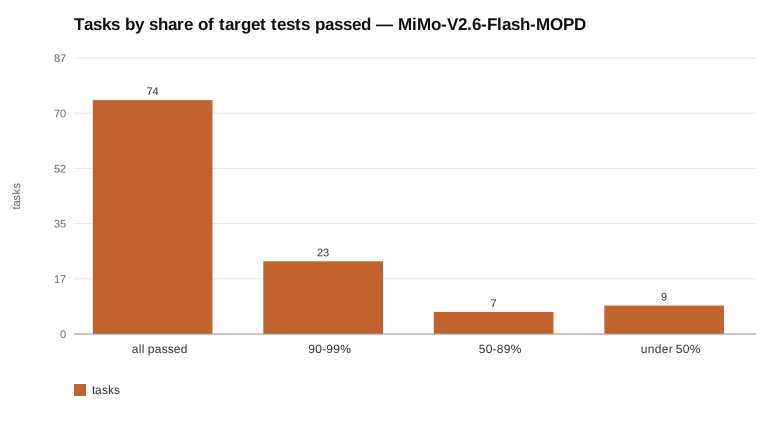
The shape is similar to GLM’s — most tasks either pass everything or land in the 90–99% band — but the tail is heavier. MiMo has 9 tasks below 50% of their target tests, against 4 for GLM, and 7 in the 50–89% band. When this model misses, it misses further.
By language
| Language | Resolved |
|---|---|
| Go | 26/35 |
| Python | 21/34 |
| TypeScript | 20/34 |
| Rust | 1/5 |
| JavaScript | 3/5 |
Go and JavaScript are where MiMo beats GLM by one task each. Python and TypeScript are where it loses ground, and Rust is a rout in the other direction: MiMo resolved one of the five Rust tasks, GLM resolved three.
Where it earns its keep
Fourteen tasks were solved by MiMo and by nothing else in this comparison: awilix-async-container-initialization, bandit-interprocedural-taint-checks, go-git-worktree-merge-conflicts, happy-dom-deterministic-intersectionobserver, ipython-session-bundle-replay, koota-pair-relation-tracking, mashumaro-flattened-dataclass-fields, onedump-dump-encryption-pipeline, prometheus-typed-label-sorting, scc-bounded-memory-spilling, superjson-error-stack-serialization, tengo-callable-instance-isolation, testem-per-launcher-reports and updo-policy-alerting.
mashumaro-flattened-dataclass-fields is the cleanest example: MiMo scored 66/66 on the target tests, GLM scored 63/66. Three assertions, one point, and the two models are on opposite sides of the line. That is the sharpest illustration I have of how much the binary metric compresses.
Its failure modes
Of the 42 failures:
- 23 near-misses in the 90–99% band.
- 3 tasks with every target test passing and a regression costing the point:
bandit-structured-nosec-directives,kombu-single-active-consumer-priorityandvulture-persistent-analysis-cache— the last one is also in GLM’s list, so two different models broke the same existing behavior on the same task. - 7 in the 50–89% band and 9 below 50%, the tail I mentioned above.
MiMo against GLM, on the same 113 tasks
| MiMo-V2.6-Flash-MOPD | GLM-5.3-Flash | |
|---|---|---|
| Resolved | 71/113 (62.8%) | 76/113 (67.3%) |
| Pooled target tests | 94.52% | 97.38% |
| Mean per task | 90.59% | 94.71% |
| Pooled regression tests | 99.984% (36 broken) | 99.993% (17 broken) |
| Steps per task | 90 | 139 |
| Longest task | 46 min | 79 min |
| Tasks under 50% of target tests | 9 | 4 |
GLM resolves more and gets closer on what it does not resolve; MiMo works more cheaply and has a narrower tail of catastrophic misses. Both statements are true at once, which is exactly the messiness the single pass-rate number hides — and the subject of the next post.
What this does not prove
- One run per task, so the interval on 71/113 is [53.6, 71.2].
- Quantized weights and a locally served endpoint, not the configuration behind the published number.
- Five Rust tasks. The 1/5 here and the 3/5 for GLM are small-sample observations, not a ranking of the models on Rust.
Reproducibility
The run is driven by the same eval/ tooling described in the GLM post: a model registry entry with the serving metadata, a scheduler that survives being stopped, and one JSON record per batch plus a full agent trajectory and verifier log per trial. All 113 verifier logs for this model were audited for environment failures (network errors during dependency fetch, or a verifier that failed in both the base and new mode) and came back clean.