Benchmarking poolside/Laguna-S-2.1-NVFP4 on RTX PRO 6000 Blackwell
Today I ran a series of local benchmarks comparing poolside/Laguna-S-2.1-NVFP4 against Qwen3.6-27B-FP8 on my RTX PRO 6000 Blackwell. At first glance, Laguna underperforms — but the HuggingFace model card claims better numbers than Qwen3.6 on SWE-bench and Terminal-Bench. So either my setup is suboptimal, or there’s a gap between the official benchmarks and real-world usage. Here are the raw results.
The Model
Laguna S 2.1-NVFP4 is a 117.6B total parameter Mixture-of-Experts model with 8.5B activated parameters per token. It uses Sliding Window Attention with per-head gating in 36 out of 48 layers, NVFP4 quantization, and a 262K context window. At ~71 GB, it fits on the RTX PRO 6000 (96 GB) with room for KV cache.
The model card claims these benchmark results:
| Model | Terminal-Bench 2.1 | SWE-bench Multilingual | SWE-Bench Pro | DeepSWE | SWE Atlas | Toolathlon |
|---|---|---|---|---|---|---|
| Laguna S 2.1 | 70.2% | 78.5% | 59.4% | 40.4% | 46.2% | 49.7% |
| Qwen 3.7 Max | 88.3% | — | — | 69% | — | — |
| Kimi K3 | 88.3% | — | — | — | — | — |
These are official numbers from the model card. My local BenchLocal results tell a different story.
BenchLocal Results: Laguna S 2.1-NVFP4
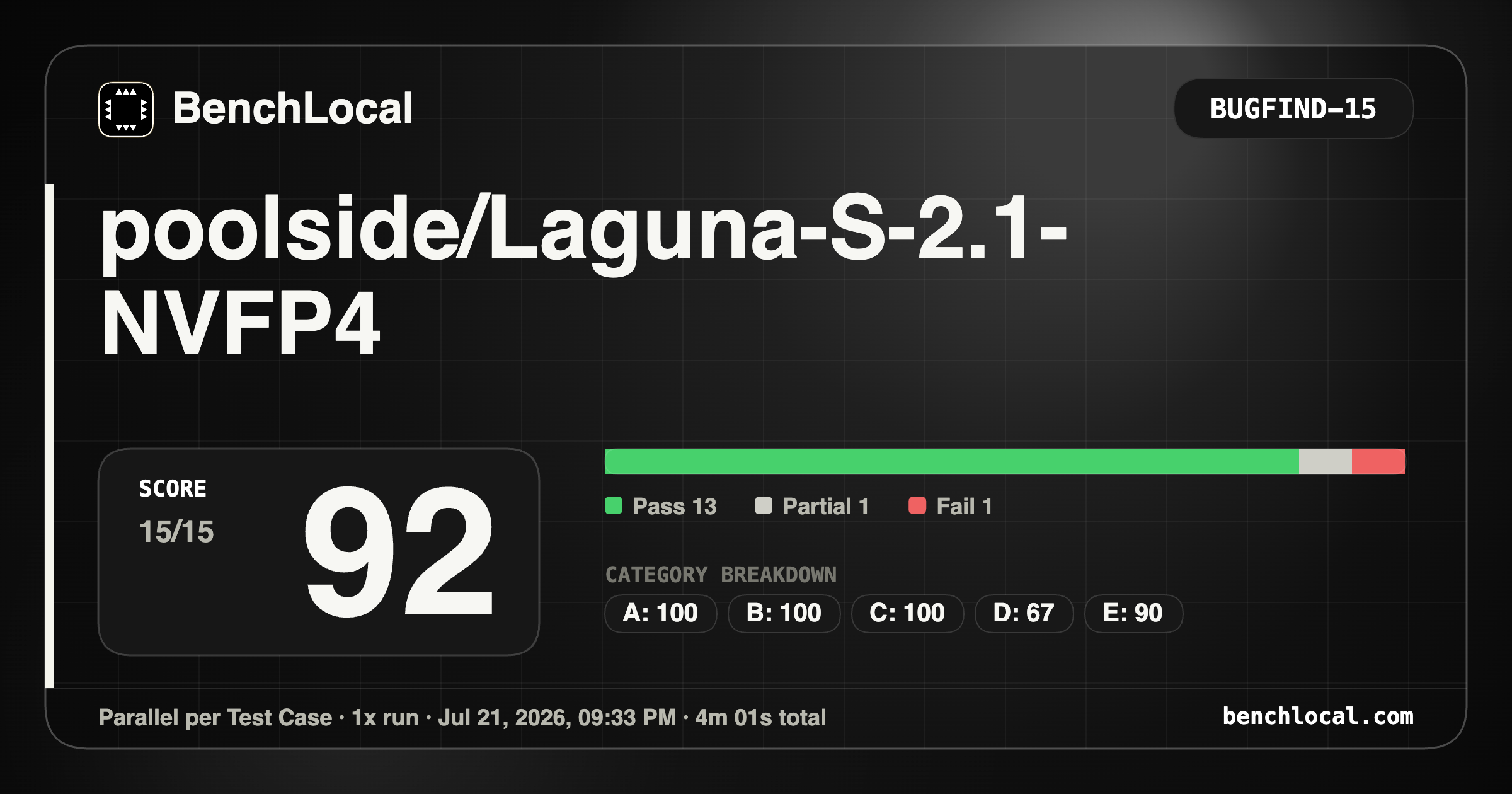
BugFind-15
| BenchLocal | |
|---|---|
| Score: 100 | A: 100 |
| Pass: 15 | B: 100 |
| Partial: 0 | C: 100 |
| Fail: 0 | D: 100 |
| E: 100 |
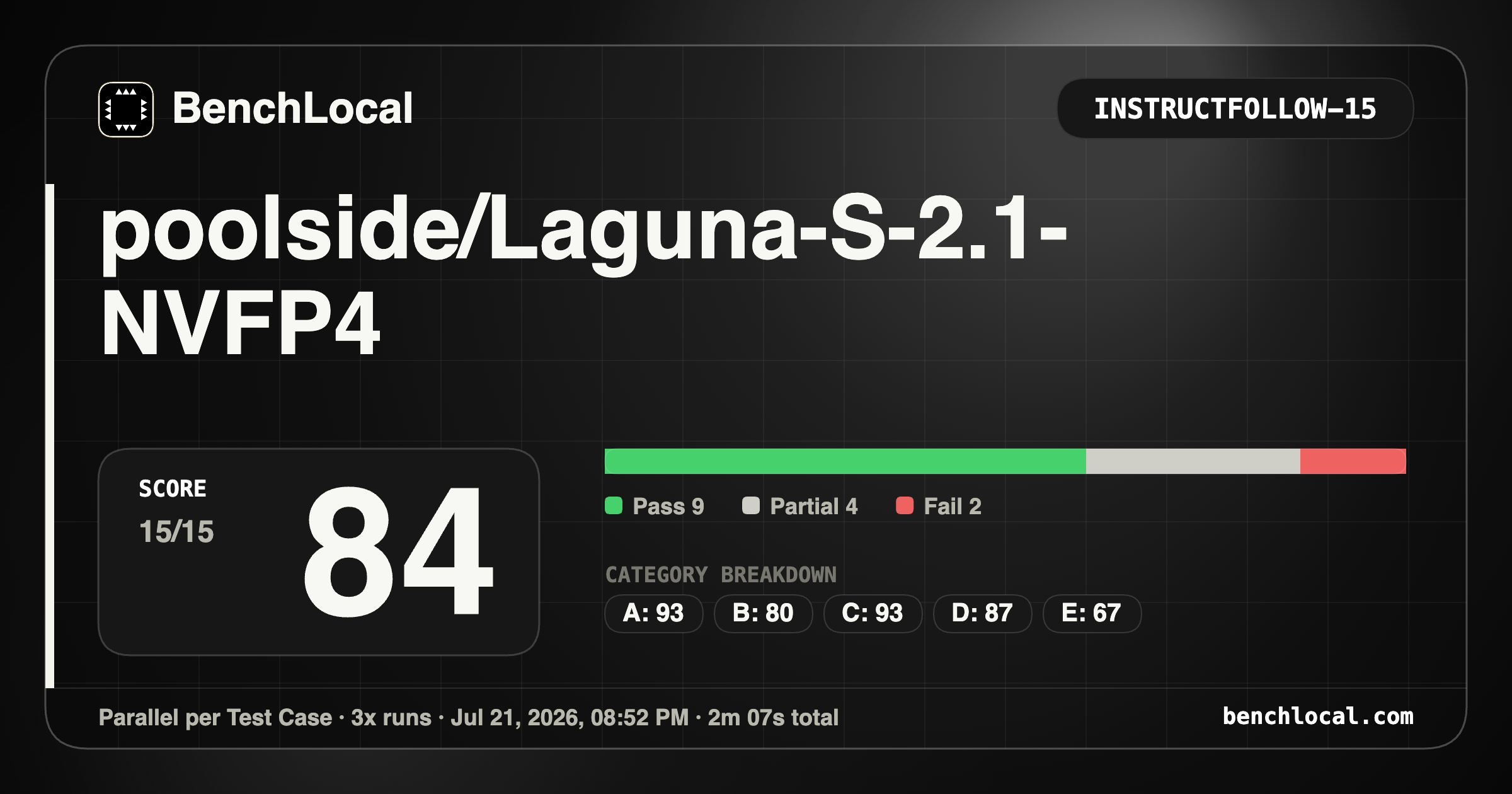
InstrucFollow-15
| BenchLocal | |
|---|---|
| Score: 84.0 | A: 92 |
| Pass: 9 | B: 80 |
| Partial: 4 | C: 93 |
| Fail: 2 | D: 87 |
| E: 67 |
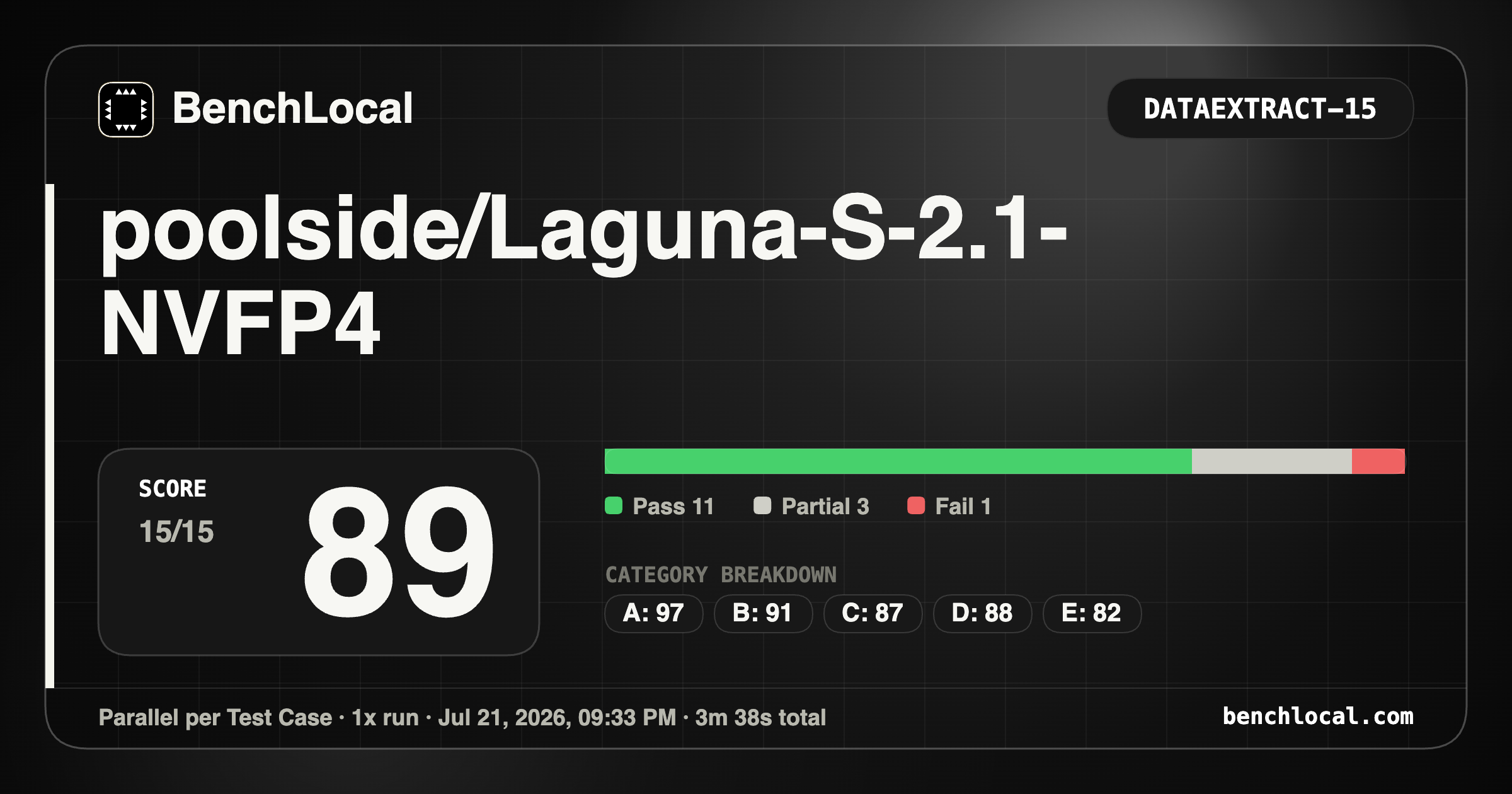
DataExtract-15
| BenchLocal | |
|---|---|
| Score: 89 | A: 97 |
| Pass: 11 | B: 84 |
| Partial: 3 | C: 87 |
| Fail: 1 | D: 88 |
| E: 82 |
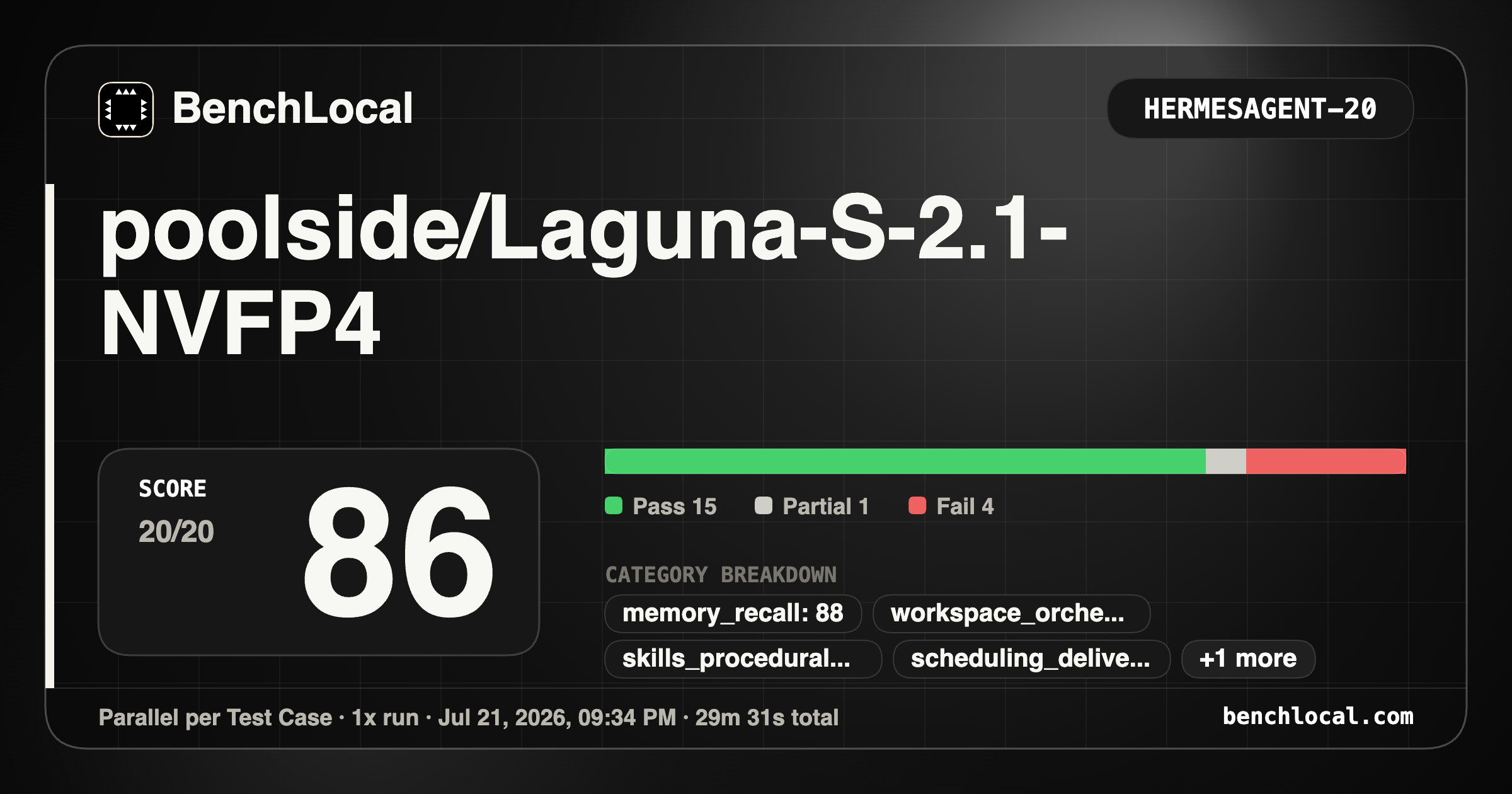
HermesAgent-20
| BenchLocal | |
|---|---|
| Score: 86 | Pass: 13 |
| Partial: 2 | |
| Fail: 5 |
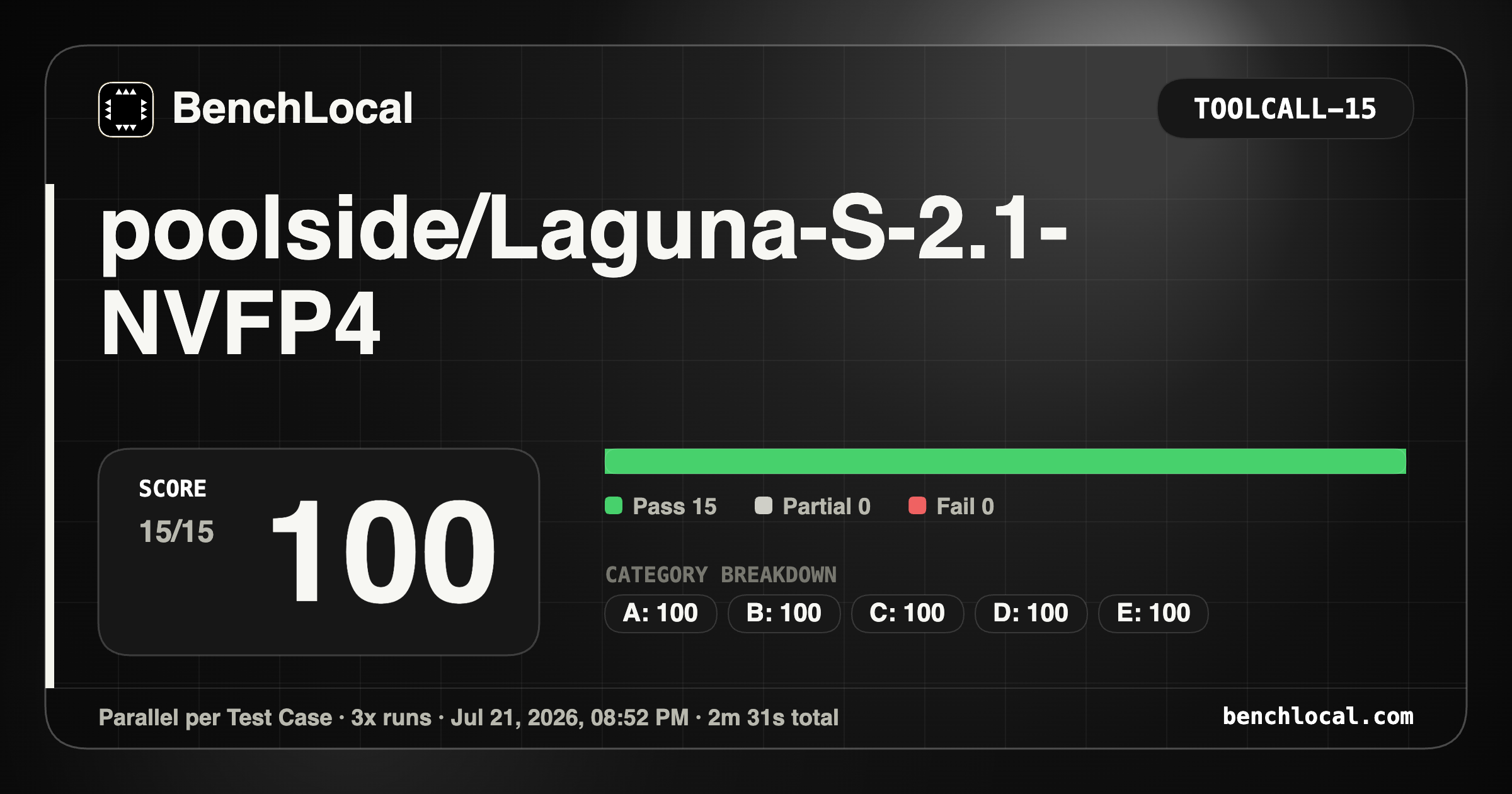
ToolCall-15
| BenchLocal | |
|---|---|
| Score: 100 | A: 100 |
| Pass: 15 | B: 100 |
| Partial: 0 | C: 100 |
| Fail: 0 | D: 100 |
| E: 100 |
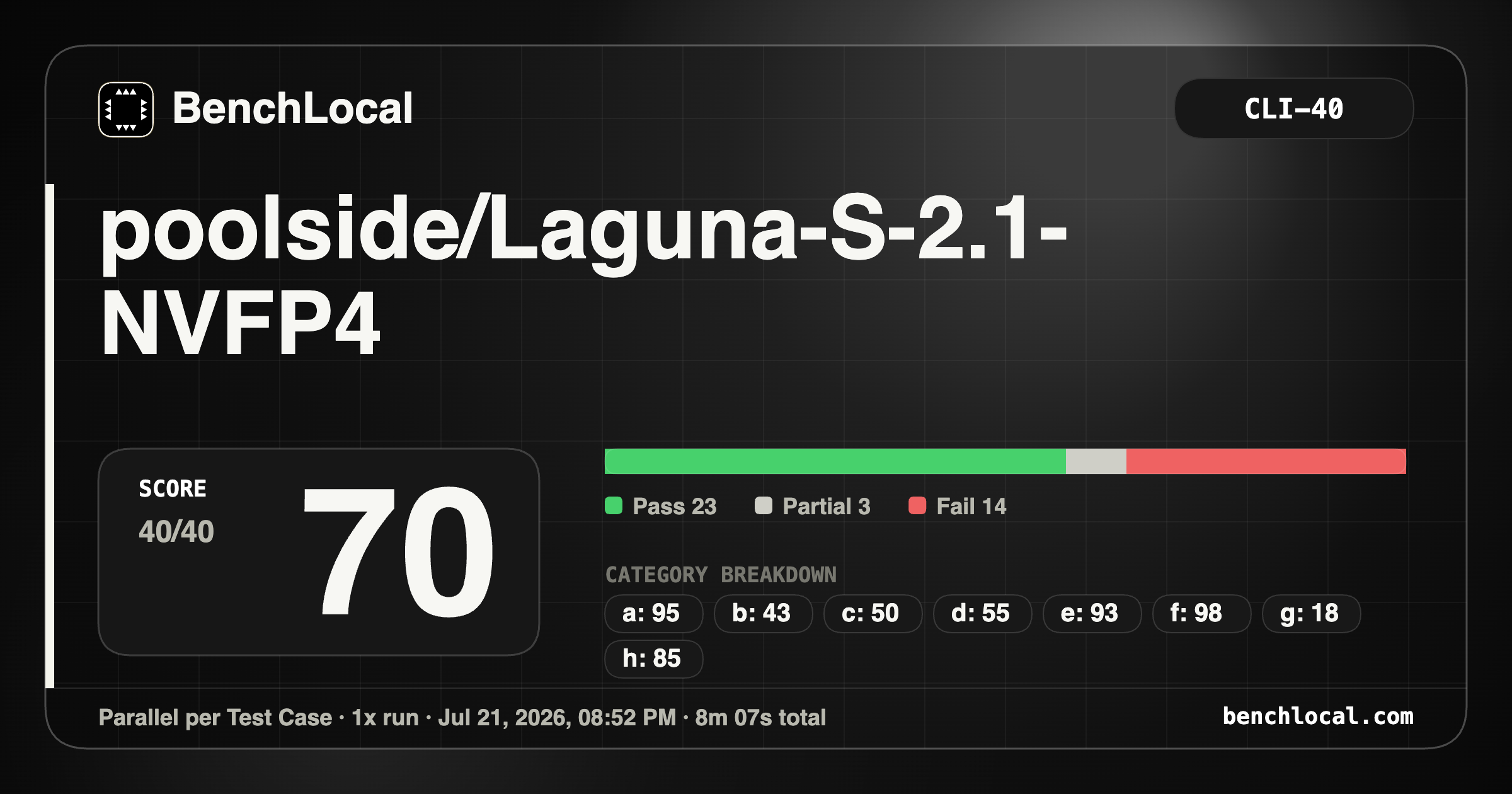
CLI-40
| BenchLocal | |
|---|---|
| Score: 70 | A: 95 |
| Pass: 23 | B: 43 |
| Partial: 3 | C: 50 |
| Fail: 14 | D: 55 |
| E: 93 | |
| F: 98 | |
| G: 18 | |
| H: 85 |
Comparison with Qwen3.6-27B-FP8
For reference, here are the Qwen3.6-27B-FP8 results from my previous benchmark run. See the full Qwen3.6 benchmarks post for details.
| Benchmark | Laguna S 2.1 | Qwen3.6-27B-FP8 | Winner |
|---|---|---|---|
| BugFind | 92 | 90 | Laguna |
| InstrucFollow | 84.0 | 97 | Qwen3.6 |
| DataExtract | 89 | 85 | Laguna |
| HermesAgent | 86 | 62 | Laguna |
| ToolCall | 100 | 97 | Laguna |
| CLI-40 | 67.1 | N/A | — |
Where the gap might come from
A few things could explain why Laguna underperforms locally despite better official benchmarks:
-
Prompt template mismatch. Laguna uses a different chat template than Qwen3.6. The default vLLM template may not be optimal for this model. The model card recommends
temperature 0.7, top_p 0.95— I used the Qwen3.6 defaults (temperature 0.6, top_p 0.95). -
No speculative decoding. Qwen3.6 was running with MTP speculative decoding (2 tokens). Laguna was not configured with a draft model. The model card mentions an optional
poolside/Laguna-S-2.1-DFlash-NVFP4draft model. -
Different benchmark scope. The official benchmarks (Terminal-Bench, SWE-bench) test coding agent workflows with specific tool environments. BenchLocal tests general instruction following, data extraction, and agent orchestration — a different distribution.
-
Model size vs. activated parameters. Laguna is 117.6B total but only 8.5B activated per token. Qwen3.6-27B is dense. For tasks that don’t benefit from the MoE routing, the smaller dense model can be more efficient.
-
Model requires fixes Laguna S 2.1 is a new model with less than a week from publication. Probably poolsideai will continue improving the different quants the have published.
The official numbers vs. local results
The HuggingFace model card shows Laguna S 2.1 scoring 70.2% on Terminal-Bench 2.1 — ahead of DeepSeek-V4-Pro Max and comparable to Qwen 3.7 Max. But my BenchLocal CLI-40 score is 67.1, which is the weakest benchmark. This suggests the model is optimized for specific agentic coding workflows (Terminal-Bench, SWE-bench) rather than general-purpose tasks.
Quickfix for version vLLM 0.25.1
There is a bug in the reasoning parser that provokes an infinite loop. To solve it, apply the following patch:
docker compose exec -it vllm-laguna bash -c \
  "python -c 'import vllm.reasoning.poolside_v1_reasoning_parser as m; print(m.__file__)'"
With this path, replace the file with the fixed version of the fork:
docker compose exec -it vllm-laguna bash -c \
  "curl -sL -o /tmp/patched.py https://raw.githubusercontent.com/nothiny/vllm/213c6e638852d6dbc0152a80dd5e9064e07a4bac/vllm/reasoning/poolside_v1_reasoning_parser.py"

docker compose cp vllm-laguna:/tmp/patched.py ./patched.py
docker compose cp ./patched.py vllm-laguna:<PREVIOUSELY_EXTRACTED_PATH>
docker compose restart vllm-laguna
vLLM Deployment Recipe
  vllm-laguna:
    image: vllm/vllm-openai:latest
    runtime: nvidia
    restart: unless-stopped
    shm_size: "16g"
    ulimits:
      memlock:
        soft: -1
        hard: -1
    environment:
      - VLLM_HOST_IP=0.0.0.0
      - HF_HOME=/root/.cache/huggingface
      - HF_TOKEN=${HF_TOKEN}
      - CUTE_DSL_ARCH=sm_120
      # - PYTORCH_CUDA_ALLOC_CONF=expandable_segments:True
    volumes:
      - ./huggingface:/root/.cache/huggingface
      - ./vllm_cache:/root/.cache/vllm
    ports:
      - "8005:8000"
    deploy:
      resources:
        reservations:
          devices:
            - driver: nvidia
              count: all
              capabilities: [gpu]
    command:
      poolside/Laguna-S-2.1-NVFP4
      --served-model-name Laguna-S-2.1-NVFP4
      --host 0.0.0.0
      --port 8000
      --trust-remote-code
      --tensor-parallel-size 1
      --max-model-len 262144
      --gpu-memory-utilization 0.95
      --max-num-seqs 16
      --max-num-batched-tokens 8192
      --enable-auto-tool-choice
      --enable-chunked-prefill
      --enable-prefix-caching
      --async-scheduling
      --tool-call-parser poolside_v1
      --reasoning-parser poolside_v1
      --default-chat-template-kwargs '{"enable_thinking":true, "preserve_thinking":true, "max_tool_response_chars":32768}'
      --override-generation-config '{"temperature":0.7,"top_p":0.95}'
      --speculative-config '{"model":"poolside/Laguna-S-2.1-DFlash-NVFP4","num_speculative_tokens":15,"method":"dflash"}'
      --kv-transfer-config '{"kv_connector":"SimpleCPUOffloadConnector","kv_role":"kv_both","kv_connector_extra_config":{"cpu_bytes_to_use_per_rank":42949672960,"lazy_offload":"false"}}'
Links
- Qwen3.6 benchmarks and vLLM recipe — the full Qwen3.6 benchmark results
- Maximizing the RTX PRO 6000 for multi-agent workflows — my Blackwell vLLM setup
- The inverted cost model — running a local 27B as orchestrator
- My OpenCode setup — multi-agent coding with local models
- The 6 phases of programmer adaptation to AI — how developers evolve with AI agents
- poolside/Laguna-S-2.1-NVFP4 on HuggingFace — model card and official benchmarks
- BenchLocal.app — the benchmark suite used